Tuesday, August 29, 2017

URGENT: Bilingual Spanish-English speakers needed for help with evacuees

Over the next 4 days, Austin will be welcoming thousands of displaced families from Houston.
There are enough English speaking volunteers but the Red Cross does not have any bilingual volunteers.
We are in desperate need of bilingual, Spanish/English speaking volunteers tomorrowmorning.
Please show up at the Delco Center 4601 Pecan Brook Dr, Austin, TX 78724 every day from now until Sunday; shifts are 9am -1pm or 1pm to 5pm.

Friday, August 25, 2017

Update: La Cosecha Dual Language Conference Registration, ABQ, NM

Registration Update - Regular Registration Deadline: September 25, 2017

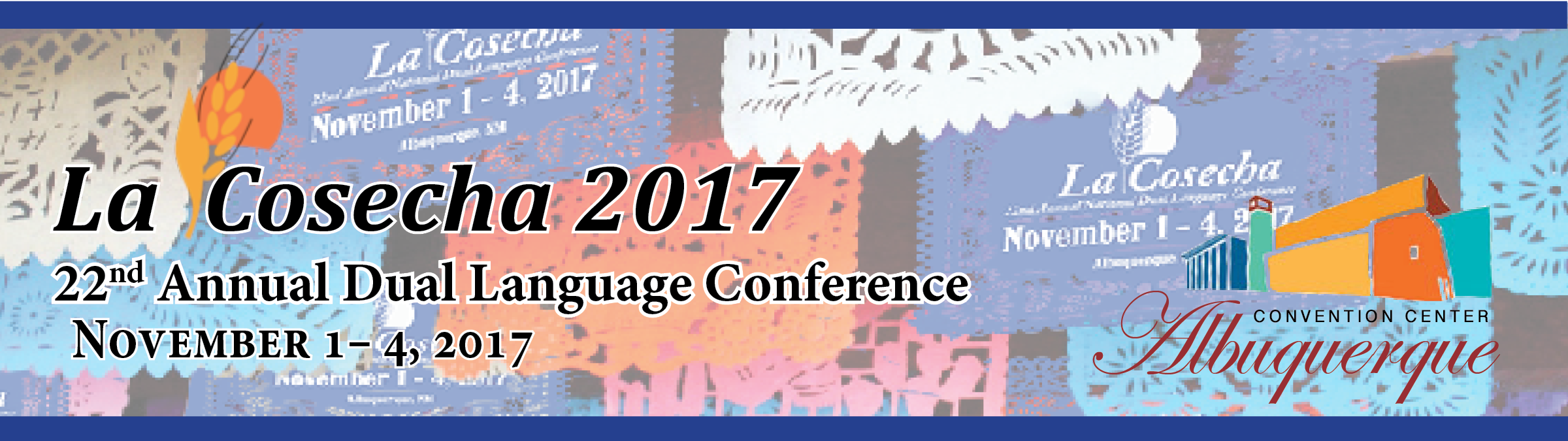
Now is the time to register for this year's 22nd Annual Dual Language Conference La Cosecha, November 1 - 4, 2017 in Albuquerque, New Mexico! Register now before the Regular Registration Deadline and save!  
La Cosecha 2017 will be bigger and better than ever this year - with more than 260 sessions and 4 days of networking with your peers. This year's conference promises to yield some of the best practices and latest research for your school and classrooms. Start planning your conference experience today, click here to for more information, including featured speakers and a conference schedule.

Questions? Give us a call at (505) 243-0648. We look forward to seeing you in November! 

¡Seguimos con La Cosecha!

Jill Hudson, Brad Neu, Bernie Chávez, Darlene Pilón, Silvia Sosa de Chávez, JoAnn García, Rosie González-Rogers, Jackie Rodríguez, Florence López, Carmen López-Gastón, Dee García, Raquel Balboa, Virginia Montoya, Alma Gamboa, José Cervantes, Marco Sandoval, Olivia Domínguez, Isai Navarrete, Jessica Chavarría, Luis García, Denelle Linebarger, José Azul Cortés, Gina González-Young, Melanie Gatewood, Kyle Roberts, Leslie Sánchez and David Rogers
La Cosecha 2017 Planning Committee
 

Wednesday, August 23, 2017

Smithsonian pre-doc opportunity-- Deadline Oct. 15, 2017

American Latino Experience Building Curatorial Excellence Pre-Doctoral Fellowships

Armed Forces History 
The Division of Armed Forces History is currently accepting applications for a one year Pre-Doctoral fellowship of $37,700 total (includes $5000 from Museum for travel and expenses) that would offer an opportunity for a fellow to conduct independent research or study focused on the experiences of Latino Americans relating to the United States military. This includes the history of Latino participation in the military, its link to citizenship, and the impact of military service on Latinos, their families, and their communities. The Fellow will have an opportunity to receive training in interpreting the existing collections through documenting American Latino stories in the collection and learning how to build new collections in the Armed Forces Division. Just as critically the Fellow will gain personal skills in collections curation, preservation, and exhibition production.
As part of this project, the Fellow will also have an opportunity to conduct independent research on a project of his or her own choosing, which relates to the history of Latino military history. A possible topic, for example, might entail the exploration of the 65th Infantry Division “Borinqueneers” history particularly during the Korean War (recent recipients of the Congressional Gold Medal, which is in our collections).Over the course of a year, the Fellow may learn about pinpointing potential objects for collection and documenting this story; this may entail collecting and researching objects, and also conducting oral histories.
Over the course of the year, the Fellow may deliver a presentation on his or her research at the National Museum of American History’s weekly colloquium, submit a research report to the Division on his or her work in this area, and offer input on a plan, which will guide the Division’s future collecting in this area. The Fellow may also submit a proposal for a conference presentation on this project at the end of the year. Proposals are welcome from doctoral students at any stage in their programs. To apply, please go to (https://solaa.si.edu/solaa/#/public) and choose the NMAH American Latino Experience Predoctoral Fellowship (Armed Forces History) Program and upload your CV, a 300 word prospectus for a project on Latino Armed Forces History and two references by 10/15/2017.

Medicine and Science
The Division of Medicine and Science is currently accepting applications for a one year Pre-Doctoral fellowship of $37,700 total (includes $5000 from Museum for travel and expenses) that would offer an opportunity for a fellow to conduct independent research or study focused on public health, medical care, and the experiences of Latino Americans. The Fellow will have an opportunity to receive training in interpreting the existing Medicine collection through research and documenting American Latino stories in the collection and learning how to build the addition of new material to the Division of Medicine and Science’s collections. Just as critically the Fellow will gain personal skills in collections curation, preservation, and documentation of objects.
As part of this project, the Fellow will also have an opportunity to conduct independent research on a project of his or her own choosing which relates to the history of Latino American health. A possible topic might, for example, entail an exploration of farmworkers’ health (in 2010, nearly half of all farmworkers in the United States were Latino, with the majority of these workers being born outside of the United States). Over the course of a year, the Fellow may learn about pinpointing potential objects for collection and documenting this important story; this may entail collecting and researching objects, and also conducting oral histories.

Over the course of the year, the Fellow may deliver a presentation on his or her research at the National Museum of American History’s weekly colloquium, submit a research report to the Division on his or her work in this area, and offer input on a plan, which will guide the Division’s future collecting in this area. The Fellow may also submit a proposal for a conference presentation on this project at the end of the year. Proposals are welcome from doctoral students at any stage in their programs. To apply, please go to (https://solaa.si.edu/solaa/#/public) and choose the NMAH American Latino Experience Predoctoral Fellowship (Medicine and Science) Program and upload your CV, a 300 word prospectus for a project on American Latino health and two references by 10/15/2017.

Please circulate this:


Monday, August 21, 2017

AERA Statement on the Hateful Acts in Charlottesville


AERA Statement on the Hateful Acts in Charlottesville

August 18, 2017


The American Educational Research Association condemns racism in all its forms and joins others throughout our nation in the fight to eradicate hate, injustice, and racial violence. The recent events in Charlottesville not only make visible how White supremacy, racism, antisemitism, religious persecution, homophobia, and xenophobia continue to permeate our society, but also remind us of the critical importance of studying, analyzing, and broadly communicating about these patterns and structures. Our social responsibility as a community of education researchers is to engage in producing knowledge and to share that knowledge with clarity and integrity.

A wide range of scholarship can and must be used to inform and engage current and future generations in the multiple stories of our pasts, the realities of our presents, and the critical demands of our futures. We need to uncover and analyze how our educational system is connected to our past and present legacies of racism in all of its forms—how our institutions and practices persistently reproduce inequities. We must also develop the knowledge and evidence that can lead to practices and policies that address hate, support understanding and respect of others, and disrupt the divisive patterns of disparity and denigration. Researchers, together with educators across all levels of education, must confront the racism, xenophobia, power and privilege, and injustice that permeate the ordinary life of our nation and world and interrogate and teach the histories of our past. No one should leave our educational institutions thinking that the expressions of hate that were on display in Charlottesville are just legitimate “points of view” or acceptable acts of “free speech.” No one should leave our classrooms or campuses believing that the symbols of oppression and killing are mere logos.

Education is fundamentally about our futures as a nation and a world, for education can empower the next generation of human beings who can promote and protect human rights, build institutions, make laws, create knowledge and art, and imagine and make possible a just world. AERA is committed to providing the knowledge base and working with other scientific organizations to support educators and others in our communities to be able to confront hate and to teach all people to know the histories of slavery, racism, genocide, inhumanity, oppression, colonialism, and White supremacy, as well as to know and learn from the stories of those who have fought and devoted their lives to justice. We strive to make known and foster the use of research on institutional and individual factors that engender prejudice and acts of violence against groups. As researchers, we must be prepared to support educators with tools, knowledge, and expertise to notice, name, deal with, and confront these issues as they arise in our contemporary world, our communities, and in our institutions and classrooms.

Now is the time, as new school and academic years commence, to ensure that we do not ignore or forget the realities that underlie what we have just experienced nor resume a normalcy that belies the scholarship that we have. AERA is committed to continuing this conversation as we go from city to city. It is our priority in planning for the 2018 Annual Meeting in April in New York and speaks to the very heart of this year’s theme—“The Dreams, Possibilities, and Necessity of Public Education.”


Deborah Loewenberg Ball, AERA President
Felice J. Levine, AERA Executive Director


Removal of Confederate Statues on the UT Campus

The University of Texas at Austin Office of the President
Photograph of The University of Texas at Austin Tower with students on the south mall.
Dear UT Community,
Last week, the horrific displays of hatred at the University of Virginia and in Charlottesville shocked and saddened the nation. These events make it clear, now more than ever, that Confederate monuments have become symbols of modern white supremacy and neo-Nazism.
After the Charleston, South Carolina, church shooting in June 2015, and with the urging of students, I formed a task force of faculty, students, alumni and university leaders to evaluate six statues on UT's Main Mall that included depictions of four military and political leaders of the Confederacy. The task force presented five options, ranging from the installation of contextual materials to the removal of some or all of the statues. At that time, I decided to move the statues of Jefferson Davis and U.S. President Woodrow Wilson. The Davis statue has since been restored and presented at UT’s Dolph Briscoe Center for American History in a scholarly exhibition about the Littlefield Fountain and the six Main Mall statues.
During the past several days, I have talked with student leaders, students, faculty members, staff members and alumni to listen to their views after the revelatory events in Charlottesville. I also revisited the very thorough 2015 task force report. After considering the original task force report and with the events of the past week and my discussions with the campus community in mind, I have decided to relocate the remaining four statues.
The statues depicting Robert E. Lee, Albert Sidney Johnston, John Reagan and James Stephen Hogg are now being removed from the Main Mall. The Lee, Johnston and Reagan statues will be added to the collection of the Briscoe Center for scholarly study. The statue of James Hogg, governor of Texas (1891-1895), will be considered for re-installation at another campus site.
The University of Texas at Austin is a public educational and research institution, first and foremost. The historical and cultural significance of the Confederate statues on our campus — and the connections that individuals have with them — are severely compromised by what they symbolize. Erected during the period of Jim Crow laws and segregation, the statues represent the subjugation of African Americans. That remains true today for white supremacists who use them to symbolize hatred and bigotry.
The University of Texas at Austin has a duty to preserve and study history. But our duty also compels us to acknowledge that those parts of our history that run counter to the university’s core values, the values of our state and the enduring values of our nation do not belong on pedestals in the heart of the Forty Acres.
We do not choose our history, but we choose what we honor and celebrate on our campus. As UT students return in the coming week, I look forward to welcoming them here for a new academic year with a recommitment to an open, positive and inclusive learning environment for all.  
Sincerely,
Signature of President Gregory L. Fenves
Gregory L. Fenves
President

NABE 2018 Registration


Registration closes
Tuesday,
January 31, 2018
NABE 2018 
Early Bird Registration
NABE 2018 Registration is open and will close on January 31st, 2018. Click the button below to register!

Click here to Register

Copyright © 2017. All Rights Reserved.
NABE Conference Coordinator's Office, P.O. Box 1569, Albany, LA 70711

Wednesday, August 9, 2017

Latino Studies 15(2): Special issue: Critical Latinx indigeneities

New Issue Alert
08/07/2017

We are pleased to deliver your requested table of contents alert for Latino Studies. Volume 15 Number 2 is now available online. 
Critical Latinx Indigeneities
Important news
2016 Impact Factors
Palgrave Macmillan is delighted to announce our latest Impact Factors according to the Web of Science 2016 Journal Citation Reports®. To celebrate, we've rounded up the top-cited articles that influenced our impact factors. Read them free until August 31st, and share them with your colleagues!
» Learn more
swanjale
In this issue
A Note from the Editor
A note from the editor
» Abstract   » Full text HTML   » Full text PDF
Introduction
Special issue: Critical Latinx indigeneities
Maylei Blackwell, Floridalma Boj Lopez & Luis Urrieta
» Abstract   » Full text HTML   » Full text PDF
Original Article
Critical Latinx Indigeneities: A paradigm drift
María Josefina Saldaña-Portillo
» Abstract   » Full text HTML   » Full text PDF
Original Article
Geographies of indigeneity: Indigenous migrant women’s organizing and translocal politics of place
Maylei Blackwell
» Abstract   » Full text HTML   » Full text PDF
Original Article
Metamestizaje and the narration of political movements from the south
Gloria E. Chacón
» Abstract   » Full text HTML   » Full text PDF
Original Article
Mobile archives of indigeneity: Building La Comunidad Ixim through organizing in the Maya diaspora
Floridalma Boj Lopez
» Abstract   » Full text HTML   » Full text PDF
Original Article
Rewriting the Mexican immigrant narrative: Situating indigeneity in Maya women’s stories
M. Bianet Castellanos
» Abstract   » Full text HTML   » Full text PDF
Viviencias: Reports From The Field
Learning from the paisanos: Coming to consciousness in Zapotec LA
Luis Sánchez-López
» Abstract   » Full text HTML   » Full text PDF
Viviencias: Reports From The Field
Coming Out as Indian: On being an Indigenous Latina in the US
Lourdes Alberto
» Abstract   » Full text HTML   » Full text PDF
Viviencias: Reports From The Field
Identity, violence, and authenticity: Challenging static conceptions of indigeneity
Luis Urrieta
» Abstract   » Full text HTML   » Full text PDF
Resúmenes
Resúmenes
» Abstract   » Full text HTML   » Full text PDF
Do you want to publish your article in this journal?
Please visit the homepage of Latino Studies for full details on:
  • aims and scope
  • editorial policy
  • article submission
Read open access articles
Click here to view all open access articles published in this journal.

Interested in publishing your article open access?
Visit the Palgrave Open website for more information on open access publishing at Palgrave, benefits to authors and how we can help you with funding queries via our free open access support service.
Further resources from Palgrave Macmillan
We publish award-winning research which changes the world across the humanities, social sciences and business for academics, professionals and librarians. Learn more at:

www.palgrave.com